














VISITORS


News & Events
Building Livelihoods through Preferential Credit in Lao Cai: From Chickens and Homestays to the Dream of Escaping Poverty
(VBSP News) A black chicken farm generating stable income, a homestay attracting visitors amid the mountains, and a family gradually overcoming hardship after years of relying solely on upland farming… all stand as vivid evidence of the meaningful impact of preferential credit in supporting ethnic minority communities in mountainous areas to build livelihoods, escape poverty, and achieve sustainable development through their own hard work and determination.
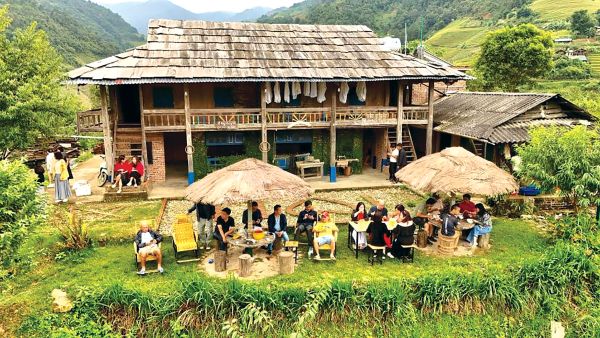
A corner of the Mu Cang Chai Big View Homestay
Small-scale models - Big pathways out of poverty
At first glance, few would imagine that these modest loans could truly change lives. Yet when looking at what those loans have created - a chicken farm filled with breeding stock, a homestay welcoming visitors, a family gradually overcoming years of hardship - the transformative power of start-up capital becomes evident. When preferential credit is translated into tangible business models, real products, and sustainable income, the true value of the policy is clearly demonstrated.
Mr. Va A Cong (from Mi Hang Tau Village, Pung Luong Commune, Lao Cai Province) is one such example. In 2019, he established a farm raising more than 1,000 black chickens, financed in part by a USD 1,900 preferential loan from VBSP. Right from the first breeding cycle, thanks to proper farming techniques, he harvested over one ton of chicken meat. With selling prices ranging from approximately USD 5 to USD 6 per kilogram, total revenue reached nearly USD 5,700. After deducting expenses, his family earned a profit of around USD 1,900 per cycle. This initial success motivated the couple to further expand their farming facilities, purchase additional breeding stock, and continue developing their livestock business.
What played a particularly important role in A Cong’s journey was the small but timely preferential loan from VBSP. He shared that although his family had long aspired to develop a business, they lacked sufficient financial resources. Of the total initial investment of more than USD 3,800, the USD 1,900 loan from VBSP was crucial for building livestock facilities and purchasing feed. According to A Cong, without this source of funding, it would have been difficult to expand production to its current scale.
Taking a different approach, Mr. Khang A Chua used preferential credit to develop community-based tourism services. With a USD 3,800 loan obtained in 2020, he built a homestay and later expanded with additional self-contained bungalows, gradually creating a stable source of income from tourism activities. If A Cong’s black chicken farm demonstrates how policy credit can be transformed into productive farming models, A Chua’s homestay illustrates how the same source of capital can be converted into tourism experiences, cultural identity, and sustainable livelihoods closely linked to local traditions.
Though pursuing different models, both share one common factor: they began with a timely financial boost that enabled A Cong and A Chua to overcome the greatest barrier faced by many poor households - the lack of start-up capital. In the journey toward poverty reduction in mountainous areas, success does not always require a large amount of money. Sometimes, what matters most is receiving the right support at the right moment so that aspirations are not extinguished before they have the chance to grow.
The effectiveness of preferential credit is reflected in real life
Models such as those of A Cong and A Chua are persuasive because they are not symbolic examples created merely for illustration. Their effectiveness is measured through tangible income, real employment opportunities, and meaningful improvements in household living conditions. A black chicken farm generating tens of millions of VND in profit per production cycle. A homestay providing steady income and enabling local people to remain on their land while earning a living from their own cultural and natural advantages. These are the most convincing indicators of effective policy implementation.
Mr. Giang A Tang, Vice Chairman of the People’s Committee of Mu Cang Chai Commune, noted that the essence of preferential credit lies in its humanitarian value, as it directly supports disadvantaged groups. Through production and business support programs, ethnic minority communities become more confident and proactive in accessing loans to develop tourism services and expand economic activities. His assessment is not merely rhetorical but has been clearly demonstrated through practical and successful livelihood models already operating in local communities.
At a deeper level, the effectiveness of preferential credit lies in its ability to change the mindset and position of borrowers. Instead of waiting for assistance, they become more proactive in planning investments, learning technical skills, expanding production, and seeking market opportunities. Rather than focusing solely on day-to-day survival, they begin thinking about preserving traditional livelihoods, maintaining their land, and encouraging younger generations to remain in their hometowns. This represents a significant transformation.
Of course, policy credit is not a “magic wand”. Not every loan will automatically lead to success. However, it provides the essential first condition by removing one of the greatest barriers faced by poor households - the lack of initial capital. The long-term effectiveness of each loan still depends on production capacity, technical support, market organization, and the determination of borrowers themselves.
Even so, enabling a young person in a remote mountainous area to seriously consider starting a business, investing in a small-scale model, and believing that they can build a stable life in their own hometown already represents a meaningful achievement. Sustainable poverty reduction does not begin with grand slogans. It begins with a profitable livelihood model, a family gradually escaping hardship, and a young person no longer feeling compelled to leave home in search of temporary work elsewhere.
And from a homestay nestled among the mountains or a chicken farm on a hillside, a pathway toward a better future is gradually taking shape.


- VBSP PROGRESS REPORT Q1/2026
- The Board of Directors of the Vietnam Bank for Social Policies Holds the Regular Meeting for the First Quarter of 2026
- Bringing digital banking services closer to the people of Thanh Hoa province
- Amplifying the impact of preferential credit in An Giang Province
- A reliable source of preferential credit supporting improvements in people’s quality of life
- Supporting disadvantaged individuals in rebuilding their lives
- Expanded preferential credit access creates more opportunities for workers to take up employment abroad
- A solid support for people seeking a second chance
- Study Visit of the Bankers Institute of Rural Development (BIRD) to Vietnam
- RDB Visits and Works with VBSP

- Building Livelihoods through Preferential Credit in Lao Cai: From Chickens and Homestays to the Dream of Escaping Poverty
- VBSP PROGRESS REPORT Q1/2026
- The Board of Directors of the Vietnam Bank for Social Policies Holds the Regular Meeting for the First Quarter of 2026
- VBSP Promotes Digital Transformation by Organizing 03 - Information Security Training Sessions for Staff
- Bringing digital banking services closer to the people of Thanh Hoa province
- Amplifying the impact of preferential credit in An Giang Province
- A reliable source of preferential credit supporting improvements in people’s quality of life
- Supporting disadvantaged individuals in rebuilding their lives
- Expanded preferential credit access creates more opportunities for workers to take up employment abroad
- A solid support for people seeking a second chance


LENDING INTEREST RATE
|
||||||||||||||||||||
DEPOSIT INTEREST RATE
|
||||||||||